Golden Edged Scalloped Potatoes Recipe

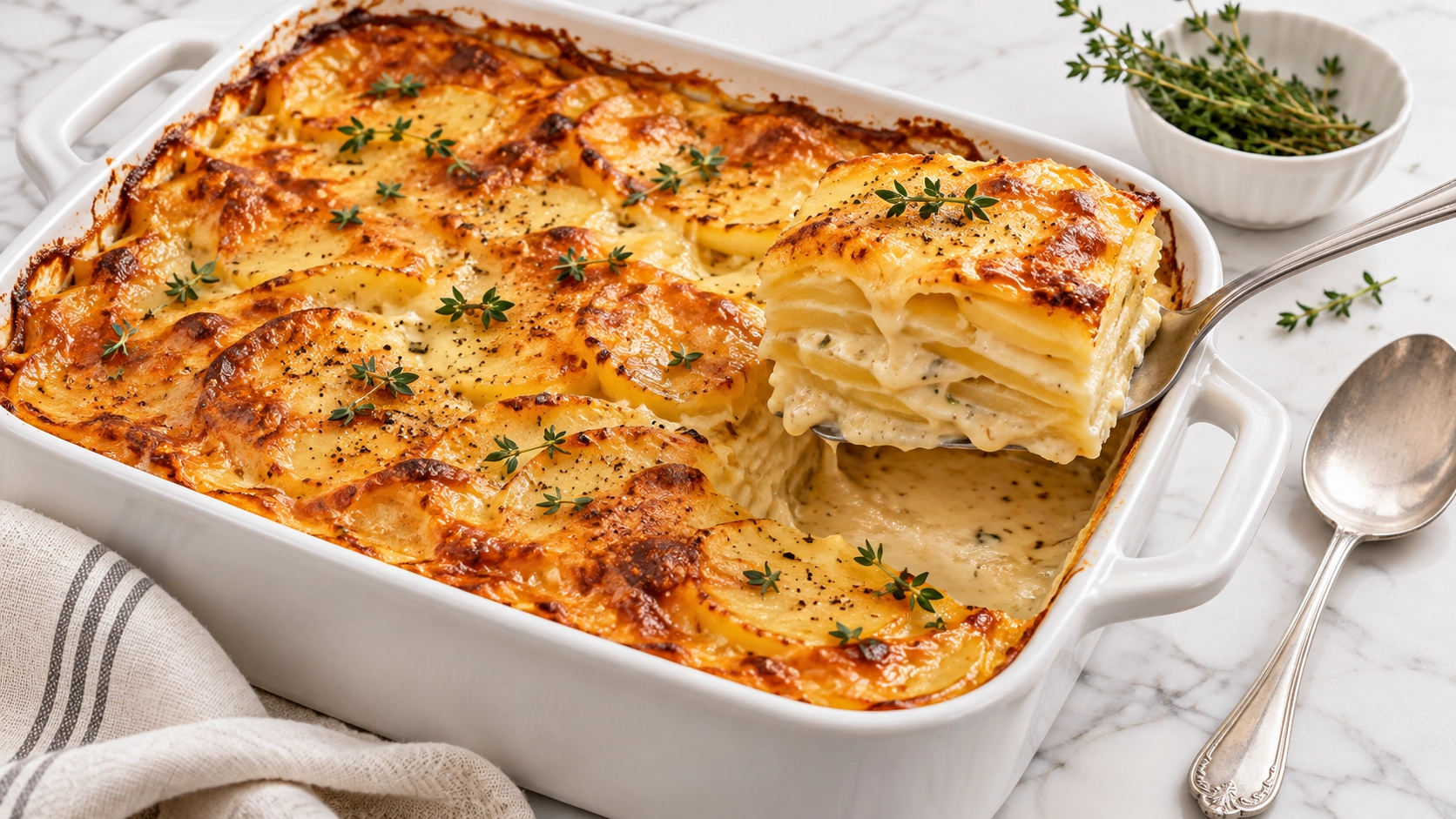
This Scalloped Potatoes Recipe layers thinly sliced potatoes with silky garlic and thyme cream beneath a golden, lightly crisp top. Rich, tender, and comforting, it makes a generous side dish for a holiday table or Sunday roast.
My first pans were disappointing. The cream split into grainy streaks, the center slices stayed firm after an hour, and the top burned while the middle was still raw. After six test bakes, I found three fixes: simmering the cream with the aromatics first, slicing every potato a uniform 1/8 inch thick, and baking the dish covered for the first 45 minutes.
What makes this version different is the infusion. Garlic, thyme, bay, and nutmeg steep in the warm cream, so every layer tastes seasoned, and the hot sauce starts the potatoes cooking right away. It needs a baking dish, a saucepan, and a mandoline. My aunt, who has made scalloped potatoes for forty Thanksgivings, took one bite and asked for the dish to bring home.
Table of Contents
Why You’ll Love This Scalloped Potatoes Recipe
- Silky, stable cream sauce made with full fat dairy, thanks to a gentle simmer and Yukon Gold potatoes
- Evenly tender potatoes from thin slices and a covered first bake
- Garlic and thyme in every layer, from a quick infusion of the cream
- Make ahead friendly, since you can bake it a day early and reheat before serving
- Easy to serve a crowd, with 8 generous squares from one 9 by 13 inch dish
- Simple ingredients, with no flour, no cheese, and no wine
Quick Information
- Prep Time: 30 minutes, including the cream infusion
- Cook Time: 1 hour 20 minutes
- Rest Time: 15 minutes
- Total Time: About 2 hours 5 minutes
- Servings: 8
- Difficulty: Medium
- Calories: 380 per serving
- Important Tool: A mandoline slicer and a 9 by 13 inch baking dish
- Best For: Thanksgiving, Christmas, Easter, Sunday roasts, or potlucks
- Course: Side Dish
- Cuisine: French inspired
- Category: Side Dishes
Nutrition Information
- Calories: 380
- Protein: 6g
- Carbohydrates: 31g
- Fat: 26g
- Fiber: 3g
- Sugar: 4g
- Sodium: 450mg
- Serving Size: 1 square (about 1/8 of the dish)
- Servings Per Recipe: 8
These scalloped potatoes are a rich holiday side, with most of the calories coming from the cream and butter. A smaller square beside a green vegetable makes a balanced plate, and using half and half in place of part of the cream reduces the richness and calories.
Nutrition information is an estimate calculated from standard ingredient values and will vary based on specific brands and portion sizes used.
Ingredients
For the Potatoes
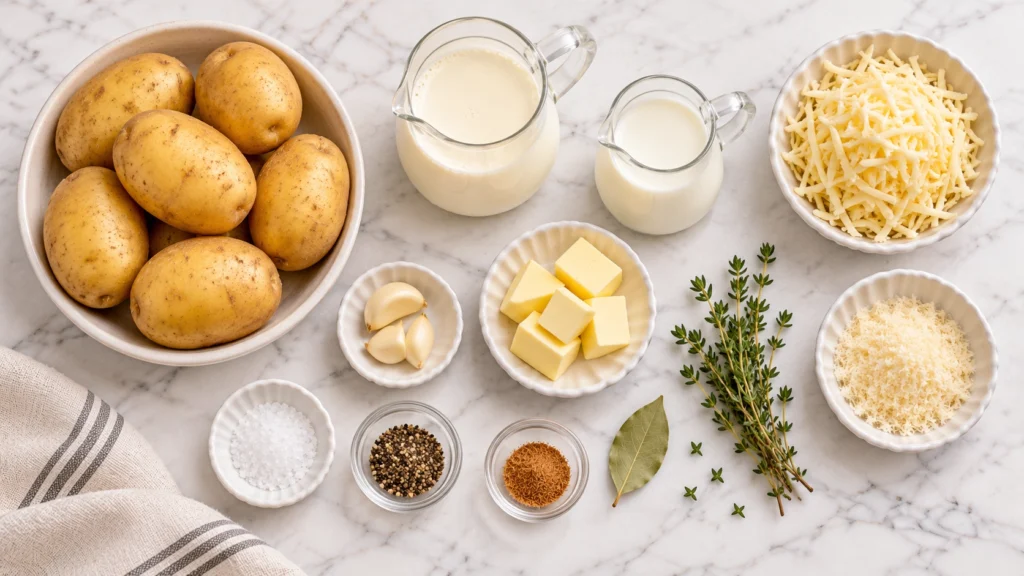
- 3 pounds (1.4kg) Yukon Gold potatoes, peeled and sliced 1/8 inch thick
- 2 tablespoons (28g) unsalted butter, softened, for greasing the dish and dotting the top
For the Garlic Thyme Cream
- 2 cups (480ml) heavy cream
- 1 cup (240ml) whole milk
- 4 cloves garlic, thinly sliced
- 6 sprigs fresh thyme
- 1 bay leaf
- 1 1/2 teaspoons fine salt
- 1/2 teaspoon freshly ground black pepper
- 1/4 teaspoon ground nutmeg
For Finishing
- 1 tablespoon fresh thyme leaves, for sprinkling
- Flaky sea salt, optional
Ingredient Notes: Yukon Gold potatoes hold their shape and release just enough starch to thicken the sauce. I tested this with Kerrygold butter and Organic Valley cream, and both gave a rich, smooth result. Use full fat cream and whole milk, since low fat dairy is much more likely to curdle in a long bake.
Tip: Do not rinse or soak the sliced potatoes. The surface starch is what thickens the cream into a silky sauce.
Equipment Needed
- Mandoline slicer: cuts potatoes into even 1/8 inch slices so they cook at the same speed
- 9 by 13 inch baking dish: holds the layers at an even depth
- Medium saucepan: simmers the cream with the garlic and herbs
- Rimmed baking sheet: catches any bubbling cream
- Aluminum foil: traps steam so the potatoes soften before the top browns
- Instant read thermometer: checks that reheated portions reach 165°F; use a knife to test potato tenderness
Practical Tip: Always use the hand guard on the mandoline, and stop slicing when the potato gets small. A cut resistant glove is a smart safety investment.
Preparation
Heat the oven to 350°F (175°C) with the rack in the center. Butter the 9 by 13 inch dish well with 1 tablespoon of the butter, including the corners, and set it on a rimmed baking sheet.
Peel the potatoes just before slicing, so they do not turn gray. Thinly slice the garlic, strip the thyme leaves from 1 tablespoon worth of extra sprigs, and measure the cream, milk, and spices.
Step by Step Instructions
1. Slice the potatoes
Preheat the oven to 350°F (175°C). Grease a 9 by 13 inch dish with 1 tablespoon of the butter and set it on a rimmed baking sheet. Peel the potatoes and slice them 1/8 inch thick on a mandoline using the hand guard, placing the slices in a large bowl. Do not rinse or soak the slices. The slices should look even and slightly translucent at the edges.
Chef’s Note: Use the mandoline hand guard and stop before the potato becomes too small to hold safely. Do not rinse away the starch.
2. Infuse the cream
Warm the cream, milk, garlic, thyme sprigs, bay leaf, salt, pepper, and nutmeg in a saucepan over medium low heat for 5 to 6 minutes, until steaming and tiny bubbles ring the edge. Take it off the heat and steep for 10 minutes, then remove the thyme and bay leaf.
3. Layer the potatoes
Arrange one third of the slices in overlapping rows in the dish, spoon over one third of the cream, and repeat twice. The layers should be level, with the cream coming about 3/4 of the way up the potatoes.
Chef’s Note: Spread the slices evenly into the corners so the middle is no deeper than the edges.
4. Press and dot
Press the top layer down gently with a spatula so the potatoes sit in the cream, and dot the surface with the remaining 1 tablespoon of butter.
5. Bake covered
Cover the dish tightly with foil and bake at 350°F for 45 minutes, until the potatoes are nearly tender and the cream bubbles at the edges.
6. Uncover and finish
Remove the foil and bake for 30 to 35 minutes more, until the top is golden, the cream is thick, and a knife slides through the center with no resistance. Use the knife test rather than a fixed temperature to judge potato tenderness; bake longer if needed.
Chef’s Note: Test several spots with a thin knife. If any slices resist, cover again and continue baking before browning the top.
7. Rest and serve
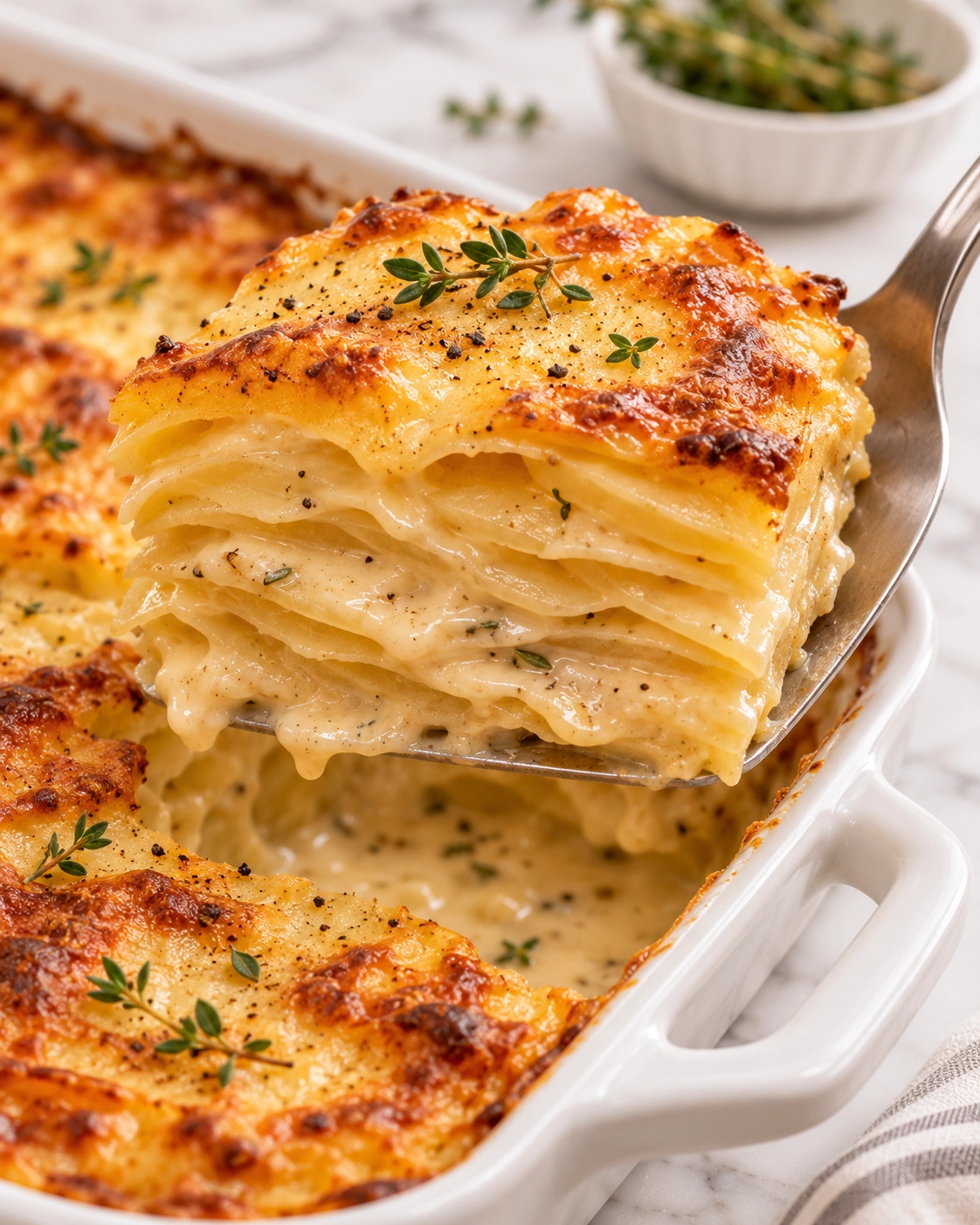
Let the dish rest for 15 minutes, so the sauce sets and the squares hold their shape. Sprinkle with thyme leaves and flaky salt, and serve hot.
Expert Tips & Tricks
- Slice evenly. Slices of the same thickness cook at the same speed, so you get no hard potatoes next to mushy ones.
- Learn from my mistake. The first time I made this, I poured cold cream over the potatoes and baked it uncovered. The edges were dry, the top browned too fast, and the center stayed raw. Warm infused cream and a covered start fixed everything.
- Warm the cream. Hot cream starts the potatoes cooking right away and helps the starch thicken the sauce.
- Keep the potatoes in the liquid. Slices that stick out of the cream dry out and brown, so press them down firmly.
- Make ahead. For the most reliable texture, bake the dish a day ahead, cool promptly in shallow portions, and refrigerate. Reheat covered until the center reaches 165°F, then uncover briefly to restore the top.
- Rest before serving. Fifteen minutes lets the sauce set, so the squares do not slide apart on the plate.
- Save time. Infuse the cream while you slice the potatoes, so both are ready at the same moment.
Common Mistakes & Troubleshooting
Curdled, grainy sauce: Boiling the cream, using low fat dairy, or adding acid can split it. Warm the cream gently, use full fat dairy, and keep the heat low. A split sauce may not become completely smooth again. Spoon a little warm cream over each serving rather than stirring and breaking the potato layers.
Hard, undercooked potatoes: Slices that are too thick, or skipping the covered bake, leave firm centers. Slice 1/8 inch thick and cover with foil for the first 45 minutes. If the potatoes are still firm, cover the dish again and bake 15 more minutes.
Runny sauce: A thin cream, too few potatoes, or cutting it too soon makes it loose. Use heavy cream, and rest for the full 15 minutes. If it is still thin, bake uncovered for 10 more minutes.
Burnt top, raw center: An oven that runs hot, or removing the foil too early, burns the surface. Check your oven with a thermometer, and tent loosely with foil if the top browns early. I once baked it uncovered from the start, and the top darkened long before the middle softened.
Gray or brown potatoes: Cut potatoes oxidize in minutes when exposed to air. Slice them just before layering and cover them with the warm cream quickly. The color is harmless, but you can prevent it by working fast.
Storage Instructions
- Room Temperature: Refrigerate leftovers in shallow containers within 2 hours, or within 1 hour above 90°F.
- Refrigerator: Store covered in an airtight container for up to 4 days.
- Freezer: Not recommended, since the cream sauce can separate and the potatoes turn mealy when thawed.
- Reheating: Warm covered at 350°F, beginning to check after 25 minutes and continuing until the center reaches 165°F. Uncover briefly at the end to crisp the top; timing depends on portion size.
- Make Ahead: Bake a day early, cool promptly in shallow portions, refrigerate, and reheat to 165°F before serving.
- My storage tip: I cut leftovers into squares and reheat them in a toaster oven at 350°F until the center reaches 165°F, uncovering at the end to bring the crisp top back.
Variations & Substitutions
- Spicy version: Add 1/2 teaspoon cayenne to the cream and sprinkle red pepper flakes between the layers.
- Mild, kid friendly version: Skip the thyme and nutmeg, and cut the finished dish into small squares.
- Vegetarian version: The recipe is already vegetarian, with no meat in the sauce.
- Gluten free version: The recipe is naturally gluten free, since it uses no flour.
- Onion version: Layer in 1 thinly sliced yellow onion, sautéed in butter until soft, between the potatoes.
- Herb version: Swap the thyme for rosemary or sage, using half as much, and strain the cream before pouring.
- Other substitutions: Replace part of the potatoes with sweet potatoes or parsnips, use half and half in place of 1/2 cup of the cream for a lighter dish, or add a layer of sautéed leeks.
Serving Suggestions
Scalloped potatoes are best served hot, with a crisp edge and a creamy center, beside roasts and fresh greens.
- Garnishes: Fresh thyme leaves, flaky sea salt, or chopped chives
- Main dishes: Roast chicken, sliced beef, holiday turkey, or baked salmon
- Fresh sides: Serve beside green beans or a fresh and colorful fruit bowl to balance the richness
- Drinks: Sparkling water with lemon, warm apple cider, or iced tea
- Dessert pairings: Finish with an Ultimate Apple Pie or a slice of Oreo cheesecake for a showstopping holiday spread
- Meal combinations: Explore more side dish recipes for other crowd pleasers
Meal Prep Tip: I bake the dish the day before a holiday, refrigerate it promptly, and plan enough oven time to reheat it to 165°F before dinner.
Frequently Asked Questions
Can I keep scalloped potatoes warm for a holiday meal?
Yes, hold the freshly baked or reheated dish in a 200°F oven, loosely covered with foil, checking that the food stays at or above 140°F. For best texture, serve within 1 hour. A preheated slow cooker can also hold it warm if the food stays at or above 140°F; do not use it to reheat a cold casserole. Tent the foil loosely so steam escapes and the top stays lightly crisp. Never leave the dish out longer than 2 hours total, since it contains dairy. If the top loses its crisp, use a broiler-safe dish and broil briefly just before serving, watching closely, so your scalloped potatoes do not burn.
Why did my scalloped potatoes turn gray or brown?
Cut potatoes oxidize within about 20 minutes when exposed to air, turning gray or brown. The color is harmless, but you can prevent it by slicing the potatoes just before you layer them and pouring the warm cream over them right away, since the cream seals out air. Do not soak the slices in water, which washes away the starch that thickens the sauce. Work quickly, and your scalloped potatoes will bake up creamy white.
Can I use half and half, milk, or coconut cream?
Half and half works in place of part of the cream, but a sauce made with only milk is thin and curdles easily. Use at least 1 cup of heavy cream for the best result. For a dairy free version, replace the cream and milk with 2 1/2 cups of full fat canned coconut milk and 1/2 cup of unsweetened oat milk, replace the butter with dairy-free butter, and expect a coconut note and a different sauce texture. Full fat cream gives the silkiest scalloped potatoes.
How long do I bake it in a smaller dish or ramekins?
For an 8 by 8 inch dish with a half batch, bake covered at 350°F for 40 minutes, then uncovered for 25 to 30 minutes. For individual 6 ounce ramekins on a baking sheet, bake covered for 30 minutes and uncovered for 15. Either way, the dish is done when the cream bubbles at the edges and a knife slips through the potatoes with no resistance. Rest for 10 minutes before serving.
What is the difference between scalloped potatoes and potatoes au gratin?
Scalloped potatoes are sliced potatoes baked in a cream or milk sauce, while potatoes au gratin add cheese and usually a browned, crunchy topping. The word gratin refers to the golden crust that forms on top. In many American kitchens the two names are used loosely, and a gratin does not have to contain cheese to have a browned crust. This is a cheese-free version of scalloped potatoes, rich with cream, garlic, and thyme.
Conclusion
The best scalloped potatoes are the ones that rest for fifteen minutes before anyone cuts into them. That short wait lets the sauce set, so each square keeps its layers on the plate, with creamy potatoes and a golden top.
I made a double dish for a family Thanksgiving last year, and the pan was empty before the turkey was carved. My cousin, who usually eats only the main dish, went back for a second square and asked if I could write down the garlic trick.
Make it once as written, then play with the herbs. A little rosemary or a layer of sautéed leeks gives these scalloped potatoes a fresh twist at every holiday.
For more easy side dish recipes like this one, follow along on Pinterest at MyRecipesDiary.

Scalloped Potatoes Recipe
Ingredients
Equipment
Method
- Preheat the oven to 350°F (175°C). Grease a 9 by 13 inch dish with 1 tablespoon of the butter and set it on a rimmed baking sheet. Peel the potatoes and slice them 1/8 inch thick on a mandoline using the hand guard, placing the slices in a large bowl. Do not rinse or soak the slices. The slices should look even and slightly translucent at the edges.
- Warm the cream, milk, garlic, thyme sprigs, bay leaf, salt, pepper, and nutmeg in a saucepan over medium low heat for 5 to 6 minutes, until steaming and tiny bubbles ring the edge. Take it off the heat and steep for 10 minutes, then remove the thyme and bay leaf.
- Arrange one third of the slices in overlapping rows in the dish, spoon over one third of the cream, and repeat twice. The layers should be level, with the cream coming about 3/4 of the way up the potatoes.
- Press the top layer down gently with a spatula so the potatoes sit in the cream, and dot the surface with the remaining 1 tablespoon of butter.
- Cover the dish tightly with foil and bake at 350°F for 45 minutes, until the potatoes are nearly tender and the cream bubbles at the edges.
- Remove the foil and bake for 30 to 35 minutes more, until the top is golden, the cream is thick, and a knife slides through the center with no resistance. Use the knife test rather than a fixed temperature to judge potato tenderness; bake longer if needed.
- Let the dish rest for 15 minutes, so the sauce sets and the squares hold their shape. Sprinkle with thyme leaves and flaky salt, and serve hot.
Notes
- Slice the potatoes evenly at 1/8 inch.
- Do not rinse the potatoes, since the starch thickens the sauce.
- Rest the dish for 15 minutes so the squares hold together.